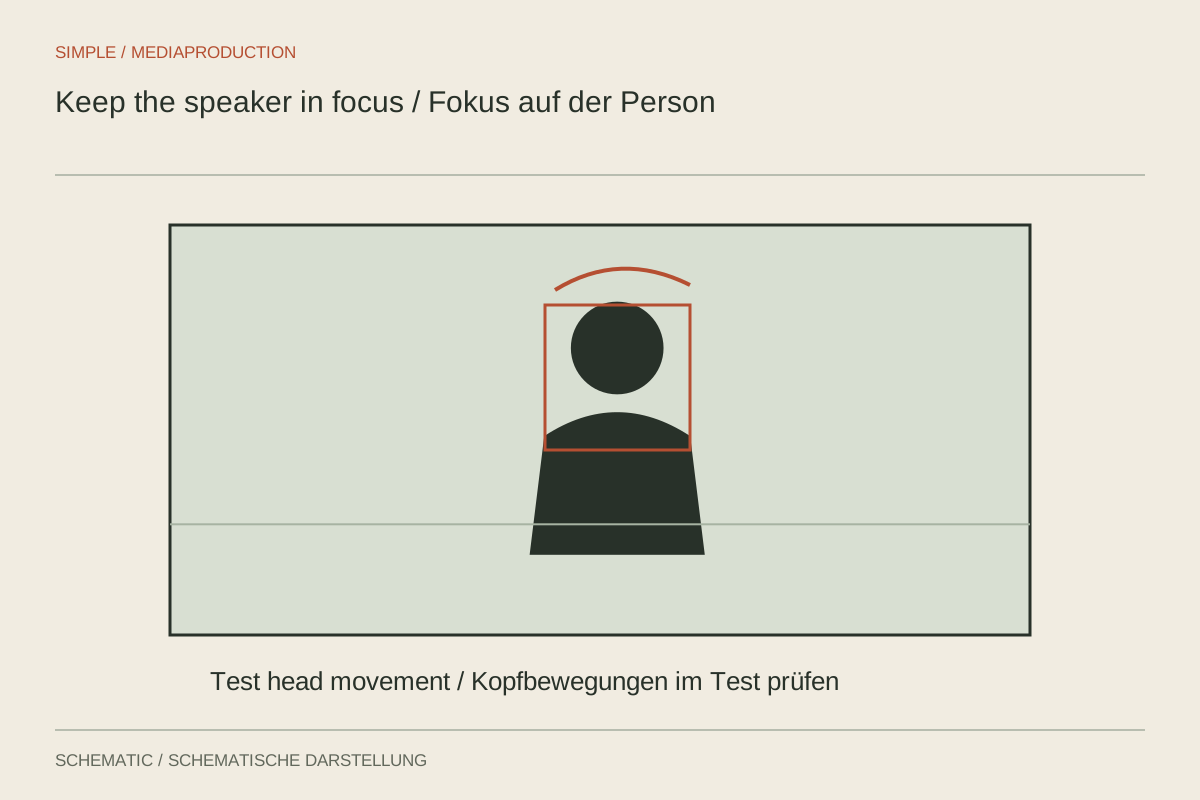
The eye remains sharp while the speaker sits still, then focus jumps to a hand or the background as they lean forward. An interview therefore needs a focusing strategy suited to the movement and camera system. Choose between dependable tracking and a sufficiently deep fixed focus zone. Either can work, but both require testing with the actual person and intended framing.
Establish the movement range
Ask the speaker to talk naturally, lean slightly forward and look towards the interviewer. These movements reveal more than a static test chart. Observe how far the eyes travel towards and away from the camera. A wide aperture can produce a very narrow focus zone that makes an animated conversation unnecessarily demanding to record consistently.
Stopping down can create more tolerance when needed. Additional light or higher sensitivity may then be necessary. Judge background separation alongside reliability rather than treating maximum blur as compulsory. A somewhat clearer background is often less distracting than eyes repeatedly falling out of focus during otherwise useful answers.
Constrain autofocus deliberately
Select subject recognition and a focus area suited to the scene where the camera provides them. A broad automatic area may respond to other people or prominent objects. Test a hand briefly covering the face and someone passing behind. Those situations reveal whether the camera holds the intended subject or switches too readily to something else.
Some devices offer separate controls for transition speed and willingness to change subjects. A slow focus move is not the same as low sensitivity to a new target. Adjust parameters using a repeatable test. Do not copy extreme values merely because they worked in another situation. The lens and camera model also affect behaviour, so the complete combination needs checking.
Focus manually and verify the margin
For a fairly fixed seated position, manual focus can provide a stable result. Magnify the live image before recording and inspect the eyes. Focus peaking highlights contrast edges and can help, but does not replace detailed inspection. Highlighted glasses or a strand of hair do not prove the eye lies on the desired focus plane.
Mark a comfortable seating position without requiring the person to remain unnaturally rigid. Repeat the trial with ordinary forward and backward movement. If that repeatedly leaves the sharp zone, change aperture, distance or focusing strategy. Setting focus on an empty chair is not a complete test of the conversation that will happen there.
Inspect the actual recording
Check a sample clip at a useful size and normal playback speed. Small displays and reduced preview resolution can conceal focus errors. Pay particular attention to recovery after an obstruction and moments of larger movement. These are often more revealing than the calm beginning of the take.
A second camera needs its own assessment. Matching aperture numbers and similar framing do not provide identical tolerance with different focal lengths, sensors or subject distances. Record the chosen approach for each camera and recheck it after any meaningful setup change rather than assuming the first successful test remains valid all day.