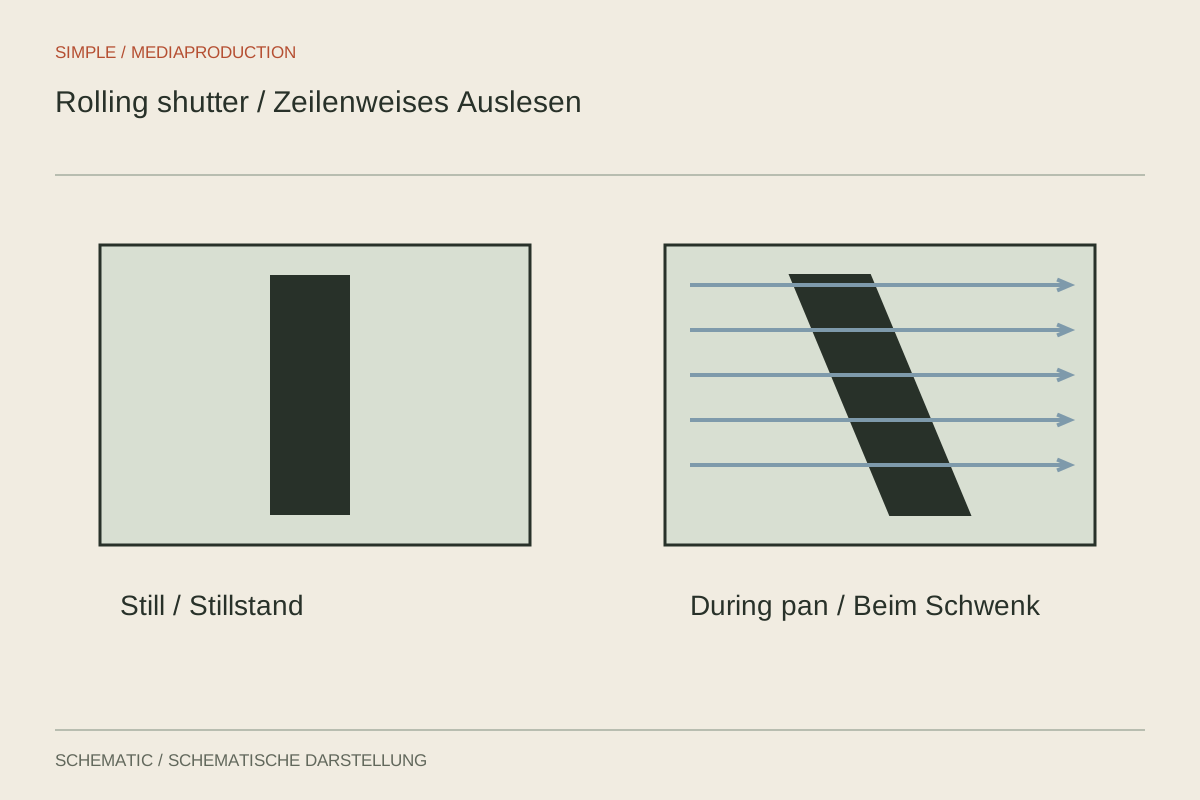
During a fast pan, a straight doorframe suddenly leans sideways. Once the camera stops, it becomes upright again. This behaviour is consistent with rolling shutter: different sensor regions capture the moment at slightly different times. If the camera or subject moves during that sequence, upper and lower parts represent slightly different positions. The result can appear skewed, stretched or wobbly.
Distinguish three kinds of instability
Motion blur produces a smeared trace within a frame. Rolling-shutter distortion changes an object's shape or orientation. Judder concerns the temporal progression between frames and may also arise from an overloaded playback device. These problems can coexist without sharing one remedy. First inspect whether a paused frame actually contains distorted lines, rather than assuming every unpleasant movement has the same cause.
A shorter exposure can capture each sensor row more sharply without correspondingly shortening the delay between rows. The doorframe may then become sharp and crooked instead of blurred and crooked. Do not confuse shutter duration with sensor readout duration. Frame rate alone also does not reliably reveal how quickly a particular recording mode reads its sensor.
Build an interpretable test
Record a vertical edge from a fixed position first. Then pan slowly and noticeably faster with the same composition. Compare frames from both movements. A line that remains straight at rest but leans during the pan suggests movement-dependent readout distortion. A line that stays curved near the frame edge may instead relate to the lens's geometric rendering.
Repeat with a faster shutter while keeping pan speed and focal length as consistent as practical. This reveals which blur disappears and which geometry remains. The exercise is not a laboratory measurement of exact readout time, but helps establish usable conditions for the equipment available. Label test files with their recording modes and settings so comparisons do not depend on memory.
Adapt movement to the camera
A slower pan reduces the positional difference occurring during readout. A shorter focal length can also reduce the visible effect of small angular movements, but changes composition. Do not simply choose the widest lens if the important subject becomes unreadable. Two static views may explain the relationship better than a rapid connecting pan that distorts the surroundings.
With a fast passing object, controlled tracking sometimes helps. The subject then moves less relative to the frame while the background moves more. Inspect both: an apparently improved person may stand against severely leaning buildings. The appropriate decision depends on which part of the picture carries essential information, rather than a desire to make one selected object look better at any cost.
Do not judge modes by their names
Different resolutions, frame rates or sensor areas may use different readout behaviour. You cannot reliably infer the better option from labels such as 4K or HD alone. Compare available combinations with the same movement. Alongside distortion, inspect detail, crop and exposure so an improvement does not quietly sacrifice another necessary part of the image.
A gimbal does not inherently eliminate rolling shutter. It can calm rotations, but a moving subject or vibration may still create distortion. On vehicles or machinery, small high-frequency movements can produce wavy shapes. Use only suitable, secure mounts and change the filming approach when vibration cannot be controlled safely and consistently.
Understand the limits of editing repair
Special correction tools can reduce simple distortions but cannot reliably reconstruct every obscured or deformed structure. Inspect edges, faces and moving details after processing. A corrected doorframe does not prove that the remainder of the picture has remained unaffected by the transformation.
If the scene can be repeated, a calmer new recording is often the better investment. Preserve the original clip and compare the correction at normal speed. The objective is understandable, credible movement, not merely one straight line in a selected paused frame that conceals problems elsewhere in the sequence.