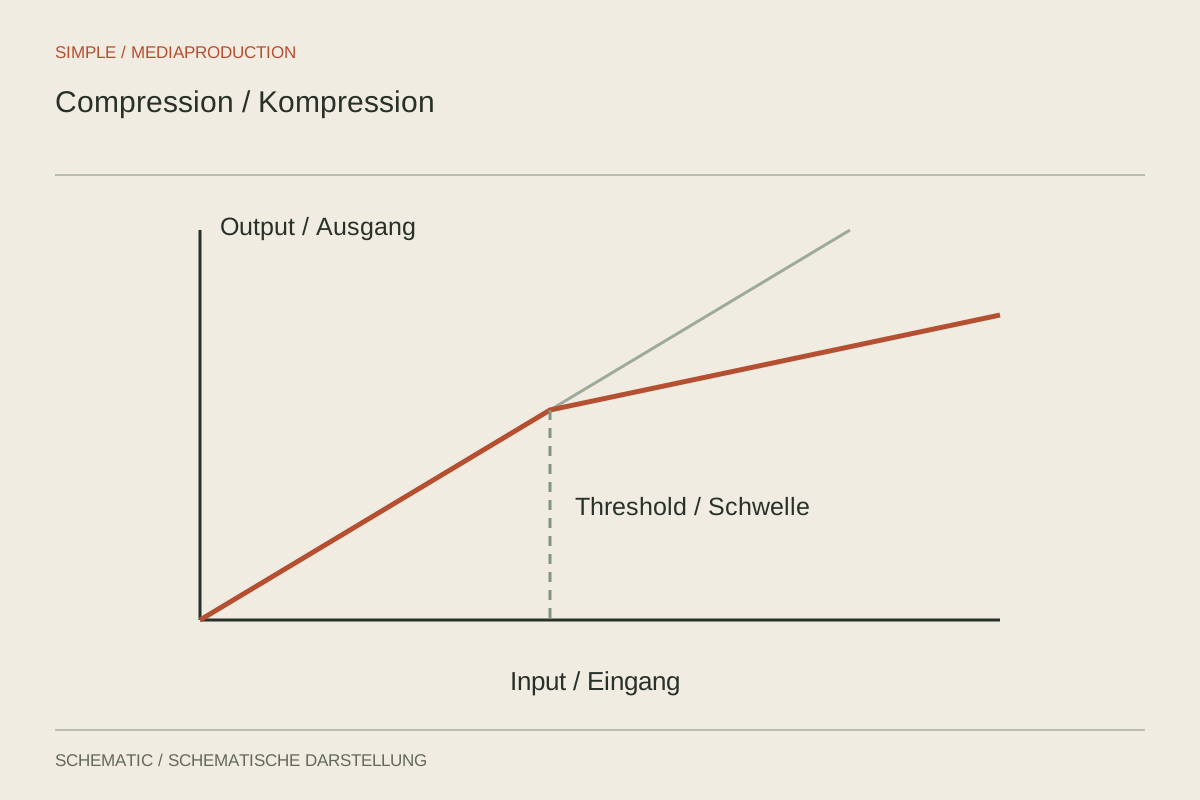
A compressor reduces louder signal portions according to its settings, which can make speech more even. It does not recognise which statement matters and cannot automatically correct arbitrary recording problems. With interviews, a little preparation is often more effective than an aggressive effect across the entire track.
Correct large differences first
Listen to the untreated track and manually correct conspicuous clip-level differences. If someone speaks a sentence far from the microphone, that passage may be both quieter and more reverberant. Raising it also raises the room sound. Decide whether another take or separate treatment would serve the edit better.
Next, choose a passage containing ordinary words, a forceful sentence and a quiet ending. This is more informative than testing only the loudest second. Include context before and after the selection so you can hear how the effect responds when the delivery changes.
Understand the controls as a system
Threshold determines the level at which compression begins. Ratio describes how strongly changes above that point are restricted. Attack and release influence the timing of the response. A low threshold with a high ratio can therefore intervene much more heavily than the same ratio at a threshold crossed only occasionally.
Start moderately and watch gain reduction while listening. If nearly every word is being heavily reduced continuously, reconsider the basic settings. Very fast reactions can blunt consonants, while unsuitable recovery times may produce pumping. A meter alone cannot determine whether speech still sounds natural.
Do not use output gain to make the processed version deliberately louder during comparison. Match perceived loudness approximately and switch between versions. Judge whether quiet words become easier to understand without breaths, room ambience and small mouth sounds moving unpleasantly into the foreground.
An interview example
Suppose a speaker begins each sentence forcefully and lets the ending fade. First raise particularly weak endings individually. The compressor then only needs to control the remaining peaks. This avoids lifting every pause unnecessarily just to make the final word intelligible.
Separate settings may help with two speakers. An animated voice and a very consistent voice trigger the same compressor differently. Bring them together in the overall mix and listen to the transitions between people. The audience should not need to change playback volume for every answer.
Recognise pumping around a pause
A common problem is a forceful syllable followed by audibly swelling room sound. First check whether output gain has raised the entire background substantially. Then observe how quickly gain reduction recovers after the syllable. An unsuitable recovery time can make ambience change in rhythm with speech.
Test a calmer setting across several sentences. Solving one pause must not leave the next sentence's opening unnecessarily suppressed. No single release value suits every speaking pace and room. Audible continuity matters more than copying a setting.
If only a few very loud sounds cause trouble, reduce them individually before compression where appropriate. The effect then needs to react less strongly. Preserve the original for comparison and check that emphasis remains understandable. The objective is a useful level distribution, not a waveform of identical height for every syllable.
A strong unwanted sound can trigger compression too. Address a desk knock at its cause or as a local disturbance where possible. Otherwise the following voice may become quieter even though it did not become louder itself. This interaction illustrates why dynamics processing should be judged after sensible preparation.
Continue checking after processing
Compression does not guarantee protection against every output peak, nor does it complete a loudness check. Measure the finished mix according to the delivery requirements. Where a platform or recipient specifies targets, those apply to the delivered file rather than one isolated dialogue clip.
Export a short passage and listen through headphones and a small speaker. Are consonants clear, pauses calm and emphasis still recognisable? If the voice sounds dense and tiring, reduce the processing. Some variation belongs to understandable, expressive speech and need not be removed completely.