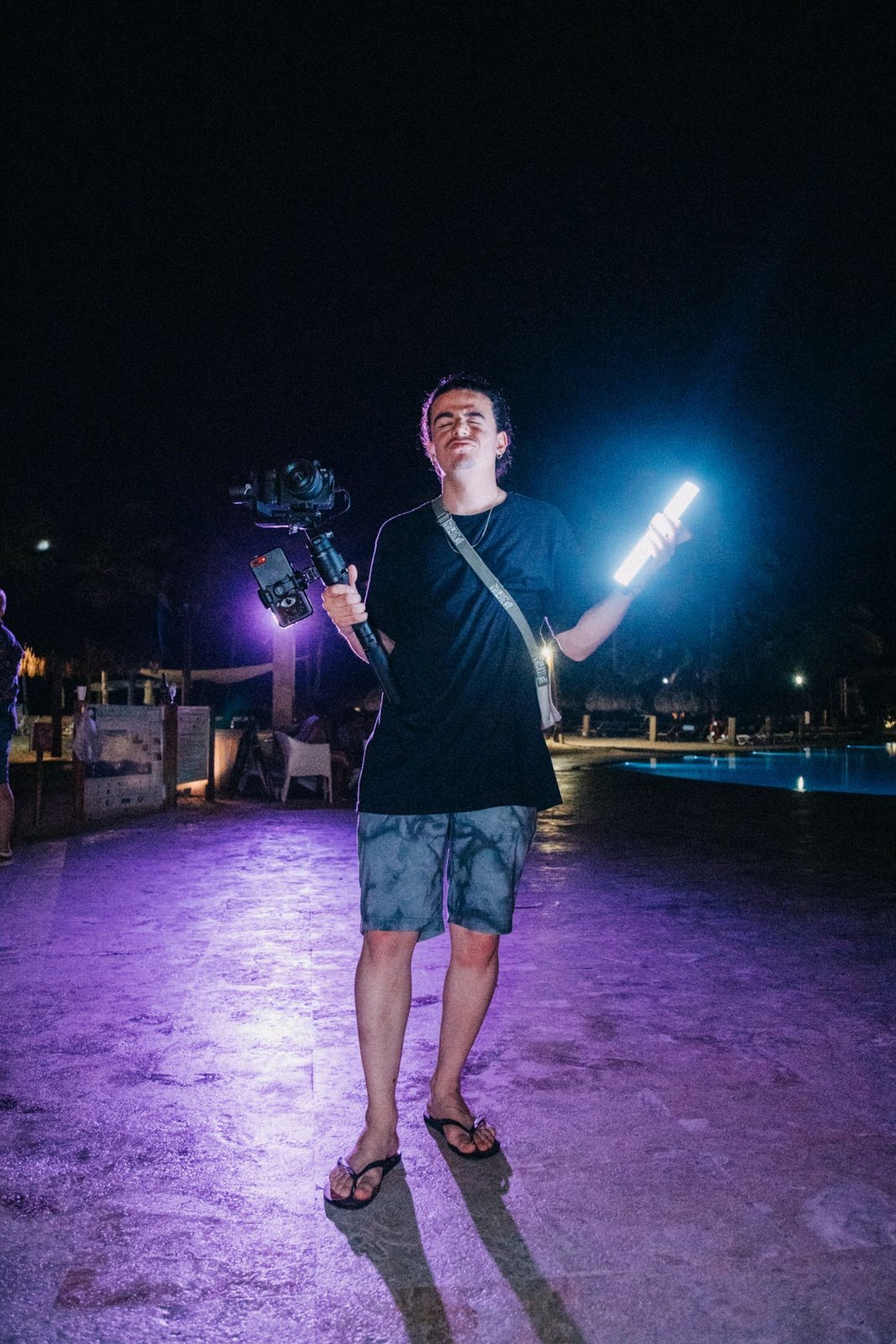
For interviews at changing locations, the important question is not how many lights you own, but whether the setup can be transported, erected securely and operated throughout the conversation. Define a typical case: one seated speaker, chest-up framing and about an hour of discussion. A kit for that situation is easier to plan than a case intended to cover every possible production.
Consider fixtures with their accessories
A compact fixture needs a suitable mount and often a modifier. Check its assembled size. A large softbox may pack flat yet block the route through a small office. Assemble the complete kit at home or in a workspace and measure the floor area it actually occupies.
Record the load the stand and mount must support. Include modifiers, cable pull and any heavy battery. Use components intended for that load. A small stand base does not become stable merely because the fixture itself is lightweight. Safe cable routes and appropriate stand security belong in both transport and setup planning.
Test power and runtime realistically
Battery runtime depends on output, temperature, battery and equipment condition. Test the intended brightness range rather than adopting only the longest advertised figure. Allow reserve for setup and repeated answers. A battery that lasts exactly as long as the expected interview may run out before the final sentence.
Mains operation requires accessible outlets and suitable cables. Check their availability at the location beforehand. Chargers, power supplies and required adapters belong on the same packing list as the fixtures. Label similar power supplies clearly so an incompatible one is not connected under time pressure.
Rehearse a setup and a fallback
For the basic case, one main fixture and a folding white or black surface may be sufficient. Practise setting these up together with the microphone and camera. Measure the time until a checked test clip, not merely until the lights switch on.
Decide what happens after a failure: use window light, change position or postpone recording. A second small lamp does not automatically replace the main source. Keep a brief setup sketch in the case and check for missing small components after each use. One forgotten mounting part can make an otherwise complete kit unusable.
Include transport in the choice
A kit that fits easily in a car may be unsuitable for a journey involving trains and stairs. Pack the entire arrangement, including stands, batteries and sound accessories, and carry it along a representative route. Check whether one person can open doors without putting delicate components down. If not, simplify deliberately. One larger case is not automatically easier than two sensibly distributed loads. What matters is getting everything to the location intact while retaining the attention needed for setup. Keep spare components accessible rather than buried beneath the whole kit, so a missing adapter does not require unpacking every item.