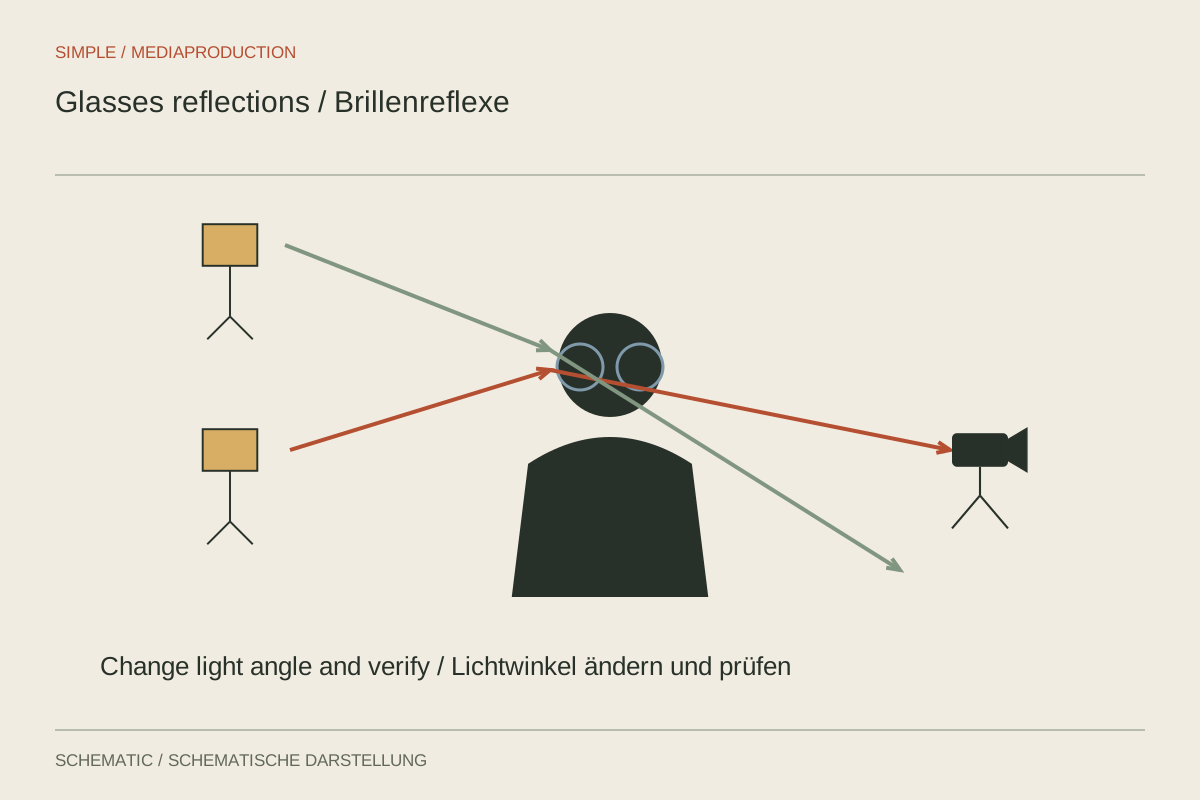
A white rectangle covering both eyes is more distracting in an interview than a small reflection near the edge of the glasses. Check reflections from the recording camera's position. The lenses may look quite different from beside the tripod. First seat the speaker comfortably and establish their normal eyeline towards the interviewer. Then look for a suitable lighting angle.
Move the light before moving the head
Raise the main light slightly and watch whether its reflection moves down and out of the visible lens. If necessary, move it farther to the side. The useful direction depends on head position, lens shape and camera position. A universal angle cannot replace this trial. Watch the shadows beneath the eyes and nose as well: clear glasses are not much help if the face becomes difficult to see.
A larger source softens shadows but may appear as a larger bright shape in the glass. Do not immediately replace it with a smaller source. Moving the near edge of the softbox out of the reflected angle may be enough. With a window, try turning the speaker and chair slightly or moving the camera sideways. Recheck framing and eyeline after each change.
Include movement in the test
Ask the speaker to say a sentence, look sideways and nod gently. A setup that works only with an absolutely still head rarely suits a conversation. Find a usable range of movement. A reflection briefly appearing at the outer edge may be less distracting than a visibly uncomfortable posture throughout the interview.
If a second small screen appears in the glasses, dim or reposition it and repeat the test. A bright wall behind the camera may also be visible. Switch suspected sources off individually instead of rearranging every lamp at random. This keeps the cause of the reflection identifiable.
When a small reflection remains
A slight change in the tilt of the glasses sometimes helps, but must remain comfortable and preserve their normal use. Ask before making adjustments. Removing the lenses is not a sensible default solution for an ordinary interview.
Judge a short recorded clip at the intended delivery size. If the eyes and expression are readable, every highlight does not need to disappear. Record the chair, camera and light positions if another shot will follow later. A different chair angle alone can bring the reflection back.
Check a second camera too
In a two-camera interview, the main view may show clear eyes while the side camera reflects the softbox strongly. Inspect both images before accepting the lighting. Improving the second camera must not silently compromise the first. If both angles cannot work together, try reducing their directional separation or moving the interviewer. The natural eyeline remains the starting point. Do not ask the speaker to maintain a different rigid head position for each camera; that would unnecessarily burden the actual conversation. Test one complete answer while watching both views, including the small nods and turns that occur naturally.