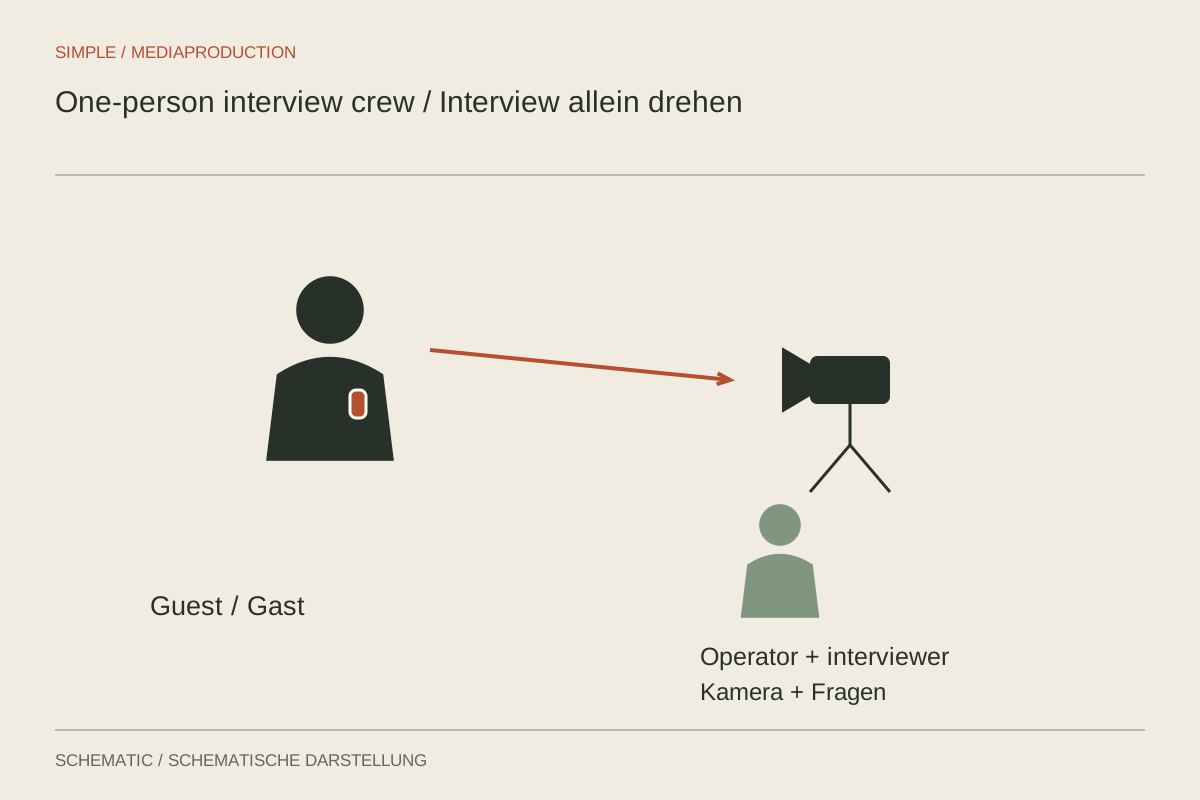
Filming an interview alone is largely an attention-management task. While listening and asking follow-up questions, picture and sound continue recording. An unnecessarily complicated setup increases the risk of missing either the conversation or a technical fault. Plan a recording that requires little intervention once it begins.
Establish a stable conversation space
Choose a quiet area and assess it by listening as well as looking. An attractive room with continuous machinery noise may be unsuitable. Consider whether doors, walkways or windows will introduce changes during the interview. Agree which interruptions can be avoided and how long the space remains available.
Mount the camera securely and allow some movement within the framing. The interviewee should sit comfortably and move naturally. Place yourself near the intended eyeline. If you move behind the camera for every question, the person's gaze will move too.
Prioritise sound over extra picture equipment
Position the microphone for the actual speaking posture and listen to a test recording. Check clothing, jewellery and contact with the table. A second camera should provide a clear benefit without demanding more attention than you can supply. A dependable main recording matters more than an uncontrolled additional angle.
Check storage, power and possible recording limits before the conversation. Start every required device and confirm its recording status. With separate sound, provide a clear synchronisation cue. A visible preview does not necessarily mean the device is recording.
Ask questions and genuinely listen
Keep prompts rather than a rigid questionnaire. Ask one understandable question at a time and let the answer finish. Nonverbal responses can encourage the speaker without repeatedly entering the audio track. If an answer remains unclear, request a concrete example instead of immediately moving to the next topic.
Where useful, ask the person to include context in the answer. An isolated “Yes, since last year” is difficult to use without the question. This should not become a memorised promotional statement, however. Let the person retain their own language and acknowledge uncertainty or limitations.
If you notice a technical fault, interrupt openly at a sensible point. Note the affected thought and repeat it after correcting the problem. A brief clean restart is preferable to continuing a long conversation whose sound is already known to be unusable.
Record supporting images afterwards
Capture relevant hands, work processes or objects in a separate session where possible. This lets you concentrate on answers during the interview. Supporting shots should genuinely relate to the statements rather than serve as arbitrary decoration or imply a different situation.
Before the person leaves, listen to some recordings and check the essential files. Missing names, numbers or brief context are easier to add now. Then secure the material systematically and retain notes on important statements or technical interruptions.